Think of psychedelics and you'll likely think of bright colors,
hallucinations, spirituality, and an overall "mystical" experience. For
centuries these drugs have been used in social, religious and medicinal
contexts by cultures across the globe. But today, the ability of these
drugs to alter our brain function is being tapped into as a potential
therapeutic for a range of mental health conditions from anxiety and
depression to addiction and obsessive compulsive disorder (OCD).
"Only by losing the self,
can you find the self," explains Dr Robin Carhart-Harris, from Imperial
College London. These may not be the usual words of a scientist but
there is biology behind them. "People try and run away from things and
to forget, but with psychedelic drugs they're forced to confront and
really look at themselves," he says.
The drugs Carhart-Harris
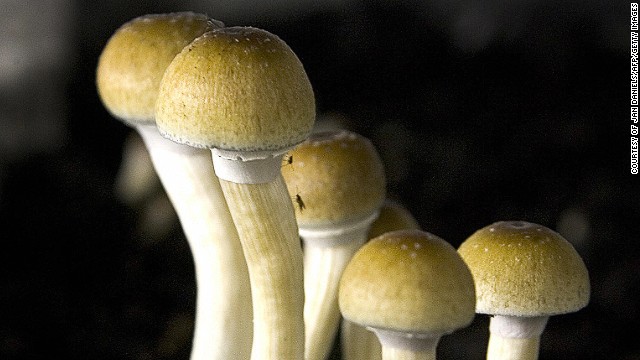
is referring to are hallucinogens such as magic mushrooms --
specifically the active chemical inside them, psilocybin. "We're
beginning to identify the biological basis of the reported mind
expansion associated with psychedelic drugs," he says. Psilocybin is not
addictive and is interesting to researchers for its ability to make
users see the world differently. The team at Imperial College has begun
to unravel why.
Carhart-Harris scanned the brains of 30 healthy volunteers
after they had been injected with psilocybin and found the more
primitive regions of the brain associated with emotional thinking became
more active and the brain's "default mode network," associated with
high-level thinking, self-consciousness and introspection, was
disjointed and less active.

Decreased
blood flow under the influence of psilocybin in regions of the brain
that are known to integrate information and mediate conscious states.
Courtesy Carhart-Harris et al. (2012) PNAS
"We know that a number of
mental illnesses, such as OCD and depression, are associated with
excessive connectivity of the brain, and the default mode network
becomes over-connected," says David Nutt, professor of
neuropsychopharmacology, who leads the Imperial College team.
Nutt was formerly drug adviser to the UK government but was fired in
2009. He "cannot be both a government adviser and a campaigner against
government policy," wrote a member of the British Parliament, at the
time.
No comments:
Post a Comment